
Mega-structures don’t just dominate skylines, they quietly choreograph the way we move. This article explores how spaces like airports, stadiums and casinos guide human flow and how parkour reframes them as stages for freedom.

Human beings are not just creatures of thought or emotion. We are creatures of space. The structures we walk through, climb, or sit within don’t merely house us; they shape how we move, feel and interact.
From airports to shopping malls, from football stadiums to casinos, from airports to college campuses, mega-structures act as silent choreographers, dictating the rhythm of our journeys. For Traceurs, this awareness comes naturally. Every ledge, every stairwell, every sweeping atrium tells a story of possibility. one that extends beyond sport into architecture, psychology and culture. In some ways, this is the essence of Parkour.
The Invisible Hand of Architecture
Most people drift through built environments without thinking about how much they are being guided. Lighting, signage, escalators and even the placement of exits are carefully calibrated to manage flow. Casinos, for instance, are famous for designing labyrinthine interiors that keep visitors immersed. But it isn’t just about keeping people inside… it’s about orchestrating a seamless experience where each transition feels natural.
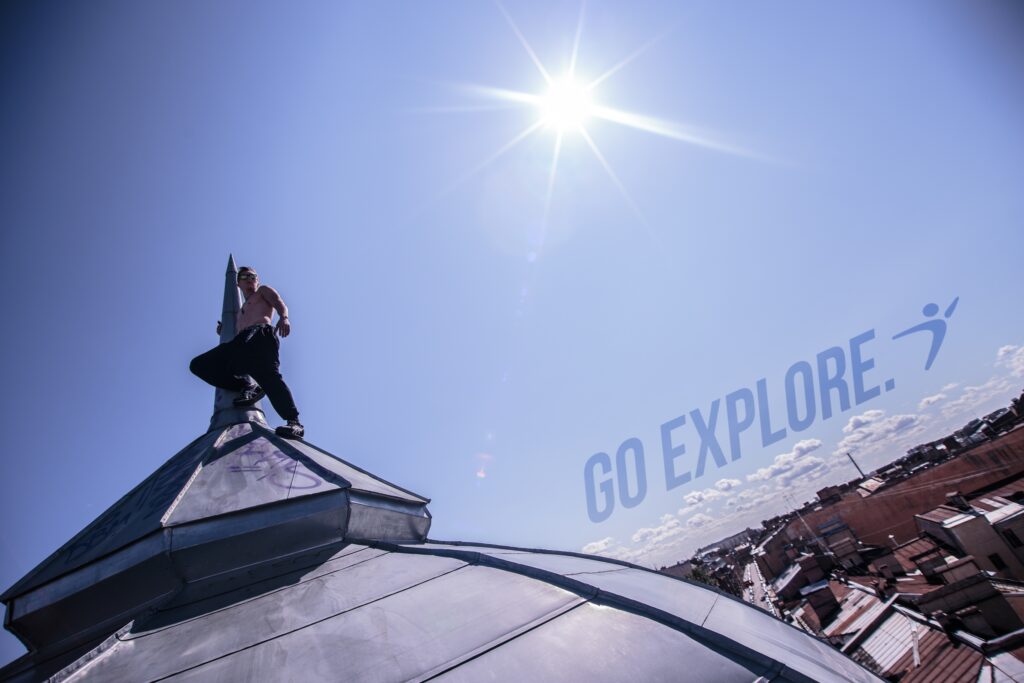
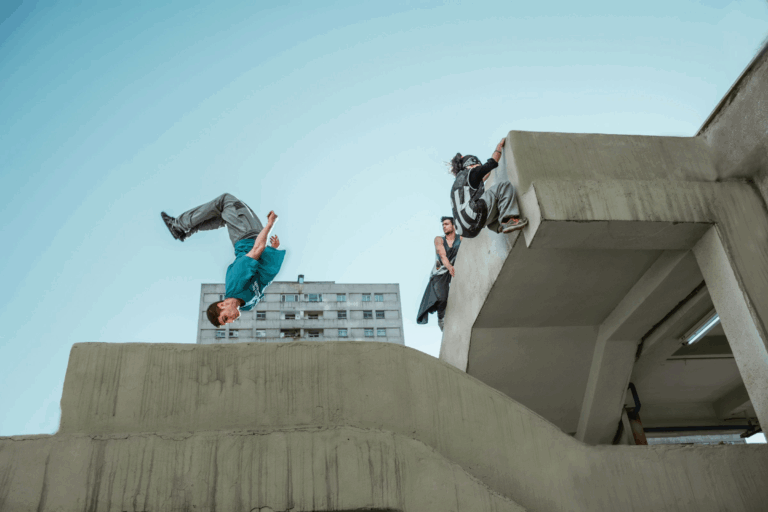
For traceurs, this design is transparent. A staircase isn’t just a staircase; it’s a rhythm of steps, a take-off point, a test of precision. What urban planners intend as “guidance,” parkour practitioners reinterpret as “challenge to take a different route” This shift in perspective highlights how our bodies are not passive recipients of architecture but active interpreters of it.
Are we being liberated by such designs, or are we being subtly constrained? Parkour insists on agency.
The Stadium as a Living Organism
Consider football stadiums. They are not only stages for sport but also living organisms that inhale and exhale crowds. On match day, thousands of bodies pulse through turnstiles, climb concrete ramps and surge into stands. The architecture amplifies emotion: steep seating tiers heighten drama, acoustics trap chants and roars and lighting transforms green turf into theater.
To a parkour lens, these structures are monumental canvases. The staircases outside Stamford Bridge or Old Trafford, for instance, are not just funnels for fans but geometric puzzles waiting to be read. These mega-structures embody the fusion of utility and spectacle, demanding that people move with a certain cadence while also leaving room for improvisation.
Resorts, Casinos, and the Digital Realm
Resort casinos offer another form of spatial theater. Their sheer size (atriums as vast as cathedrals, rooftop gardens, glass-fronted towers) blur the line between city and building. They are, in effect, mega-environments: contained worlds designed to suspend reality.
Here, the comparison to digital environments becomes clear. Just as physical resorts guide bodies through spectacle, online platforms structure how users move through interfaces. For example, Instagram, TikTok, eCommerce sites, and even 10 dollar deposit casinos all provide a low barrier of entry, a kind of “architectural on-ramp” for participation in digital leisure. While one forum exists in concrete and glass, the other is coded in algorithms and interfaces. Both highlight how design mediates access and experience.
Flow States and Designed Journeys
In Parkour, practitioners speak often of “flow,” aka the ability to move seamlessly from one obstacle to another in a rhythm that feels almost inevitable. Architects and entertainment designers pursue the same effect. Whether it is the curved escalators in a shopping mall or the sightlines within a Formula One paddock, environments are sculpted to eliminate friction.
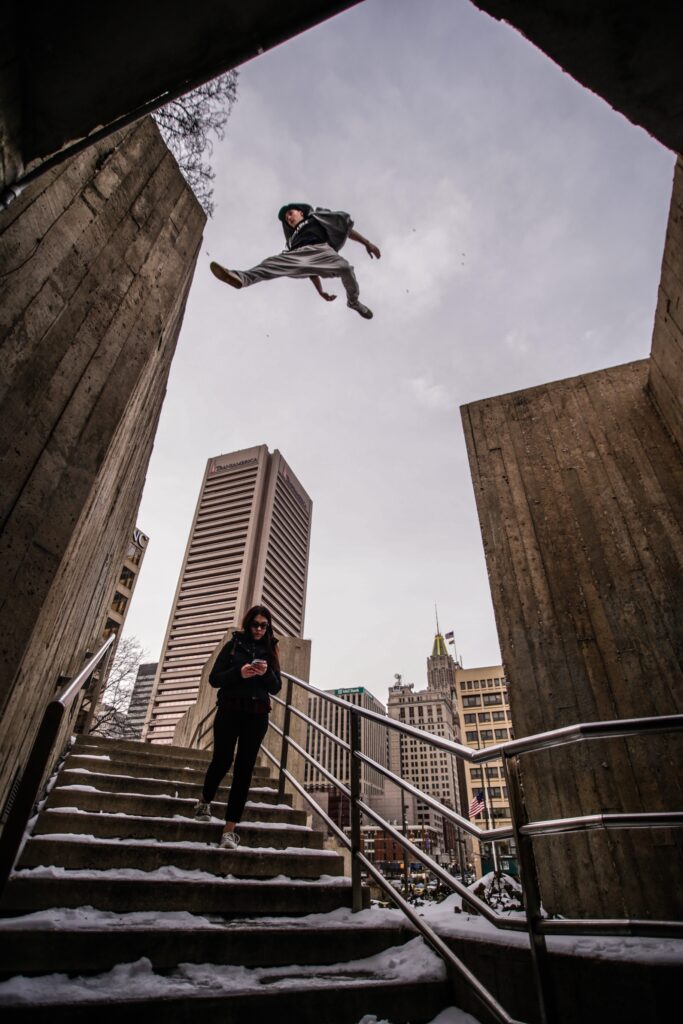
This pursuit of flow reveals a philosophical tension. Are we being liberated by such designs, or are we being subtly constrained? Parkour insists on agency: to move beyond the prescribed, to vault over the guardrail instead of walking around it, to invent movement where none was intended. In this sense, parkour becomes not just a sport but a critique of architecture itself.
To traceurs, these structures are not simply bottlenecks of stress and routine but potential arenas for exploration.
Airports, Transit and the Movement of Masses
Nowhere is the choreography of space more visible than in airports. These vast structures are built not just to accommodate human movement but to regulate it (from check-in to security to the departure gate). The design of airports is often critiqued for its cold efficiency, but in another light, they represent the pinnacle of spatial problem-solving.
Parkour’s dialogue with such spaces is particularly provocative. While airports are rigidly controlled environments, their design inadvertently creates opportunities: handrails, walls, railings and expansive plazas. To traceurs, these structures are not simply bottlenecks of stress and routine but potential arenas for exploration.
The same stairwell may feel like a barrier to one person, a stage to another and a leap of faith to a Traceur.
A Wider Culture of Space
Ultimately, mega-structures remind us that movement is a dialogue. Architects build, planners guide and engineers calculate… but bodies interpret. The same stairwell may feel like a barrier to one person, a stage to another and a leap of faith to a traceur. Recognizing this multiplicity is essential not only for athletes but for anyone trying to understand how culture and architecture intertwine.
Even digital culture reflects this. The same design philosophies that shape airports or casinos also underpin the way we navigate apps, websites, movies, or even social media feeds. Flow, risk, reward and access: they are universal concepts, whether in physical or digital space.
Reclaiming Movement
Mega-structures dominate the modern landscape, and they will only grow larger and more complex. But within their steel and glass, there remains room for improvisation, for rewriting the script of movement. Parkour offers one response: a reminder that our bodies are not passive in the face of architecture but active agents capable of transforming space into experience.
The next time you step into a stadium, a resort, or even a cavernous airport terminal, notice the choreography at work. And then ask yourself: am I following the intended script, or am I ready to write my own?